Back
16
Relief from Abnormal Course Conditions (Including Immovable Obstructions), Dangerous Animal Condition, Embedded Ball
Jump to section
Print Section
16Relief from Abnormal Course Conditions (Including Immovable Obstructions), Dangerous Animal Condition, Embedded Ball
16
Relief from Abnormal Course Conditions (Including Immovable Obstructions), Dangerous Animal Condition, Embedded Ball
Purpose of Rule: Rule 16 covers when and how the player may take free relief by playing a ball from a different place, such as when there is interference by an abnormal course condition or a dangerous animal condition.
- These conditions are not treated as part of the challenge of playing the course, and free relief is generally allowed except in a penalty area.
- The player normally takes relief by dropping a ball in a relief area based on the nearest point of complete relief.
16
Relief from Abnormal Course Conditions (Including Immovable Obstructions), Dangerous Animal Condition, Embedded Ball
16.1
Abnormal Course Conditions (Including Immovable Obstructions)
This Rule covers free relief that is allowed from interference by animal holes, ground under repair, immovable obstructions or temporary water:
- These are collectively called abnormal course conditions, but each has a separate definition.
- This Rule does not give relief from movable obstructions (a different type of free relief is allowed under Rule 15.2a) or boundary objects or integral objects (no free relief is allowed).
16.1a
When Relief Is Allowed
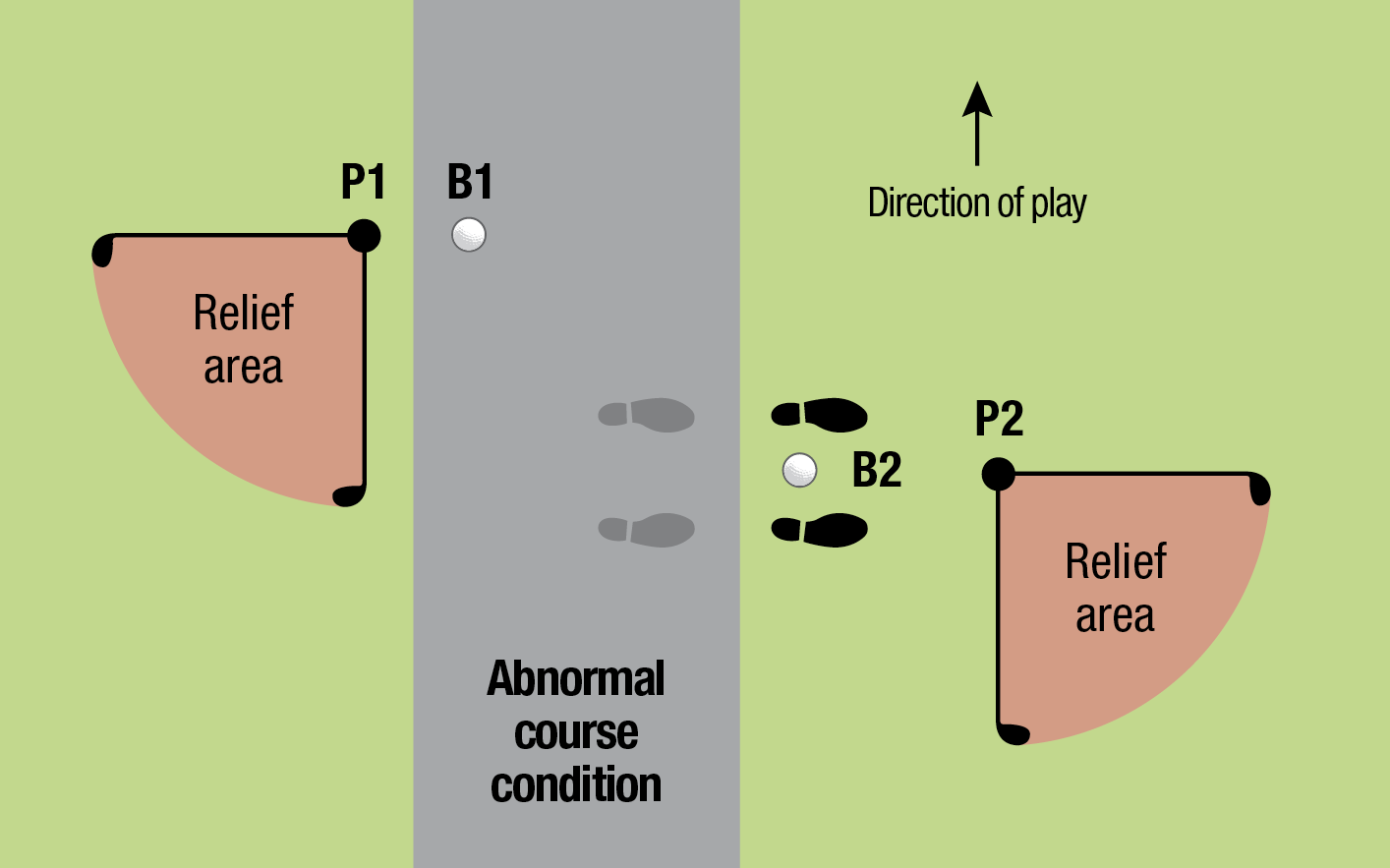
(1) Meaning of Interference by Abnormal Course Condition. Interference exists when any one of these is true:
 (2) Relief Allowed Anywhere on Course Except When Ball Is in Penalty Area. Relief from interference by an abnormal course condition is allowed under Rule 16.1 only when both:
- The player’s ball touches or is in or on an abnormal course condition,
- An abnormal course condition physically interferes with the player’s area of intended stance or area of intended swing, or
- Only when the ball is on the putting green, an abnormal course condition on or off the putting green intervenes on the line of play.
MCHORO 16.1a: WAKATI NAFUU INAPORUHUSIWA KWA AJILI YA HALI ISIYO YA KAWAIDA YA UWANJA
- Mchoro unadhani kwamba mchezaji ni wa kutumia mkono wa kulia.
- Nafuu ya bure ianruhusiwa kwa mwingiliano unaosababishwa na hali isiyo ya kawaida ya uwanja (ACC), ikiwemo kizuizi kisichoweza kuondolewa, wakati mpira unagusa au uko juu ya hali hiyo (B1), au hali hiyo inaingiliana na eneo la msimamo uliokusudiwa (B2) au mzunguko wa kupiga.
- Sehemu ya karibu kabisa ya nafuu kamili kwa B1 ni P1, nayo iko karibu sana na hali hiyo.
- Kwa B2, sehemu ya karibu kabisa ya nafuu kamili ni P2, nayo iko mbali zaidi na hali hiyo kwa kuwa msimamo lazima uwe hauingiliana na ACC.
- The abnormal course condition is on the course (not out of bounds), and
- The ball is anywhere on the course, except in a penalty area (where the player’s only relief is under Rule 17).
- When playing the ball as it lies is clearly unreasonable because of something from which the player is not allowed to take free relief (such as when a player is unable to make a stroke because of where the ball lies in a bush), or
- When interference exists only because a player chooses a club, type of stance or swing or direction of play that is clearly unreasonable under the circumstances.
16.1b
Relief for Ball in General Area
If a player’s ball is in the general area and there is interference by an abnormal course condition on the course, the player may take free relief by dropping the original ball or another ball in this relief area (see Rule 14.3):
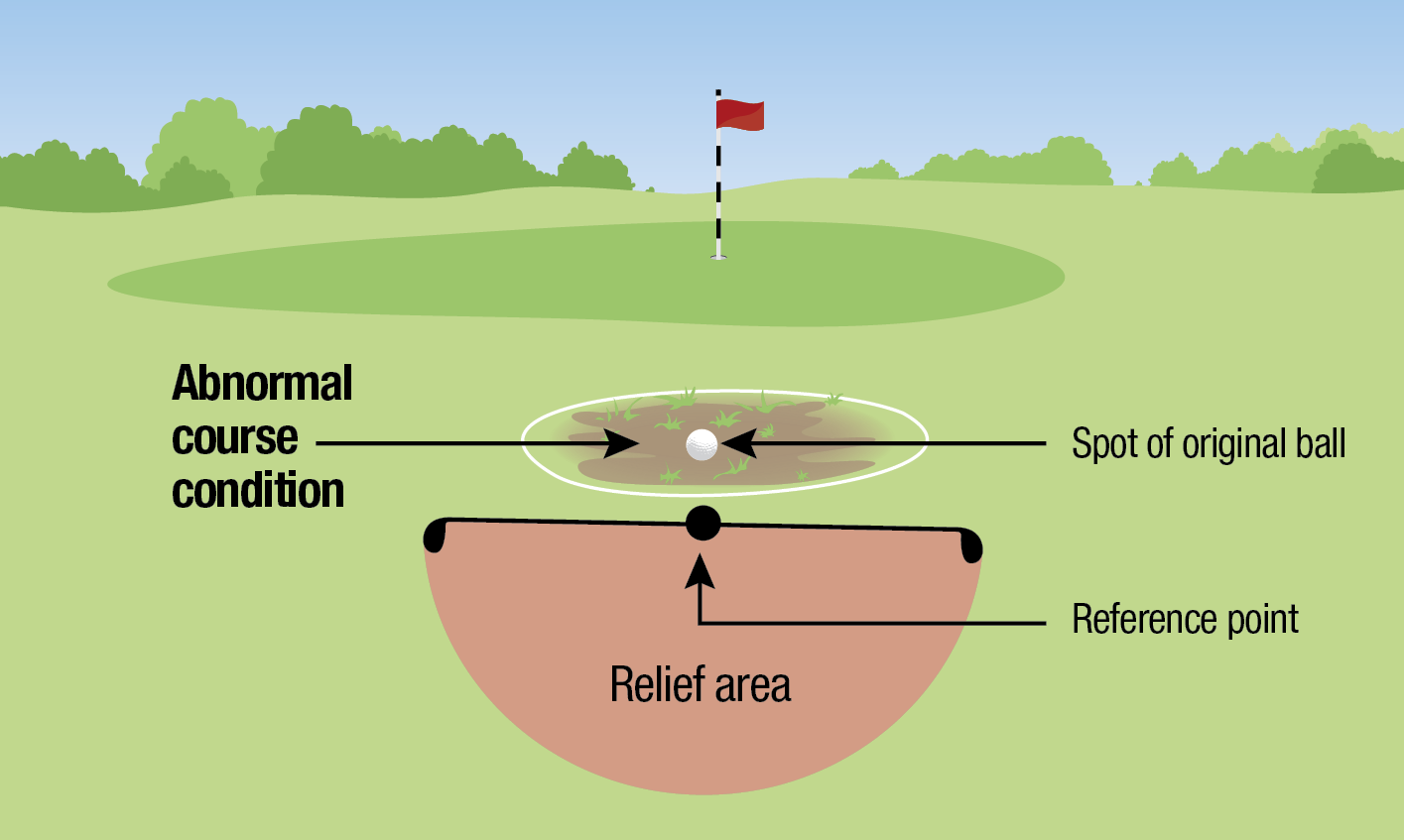
- Reference Point: The nearest point of complete relief in the general area.
- Size of Relief Area Measured from Reference Point: One club-length, but with these limits:
- Limits on Location of Relief Area:
- Must be in the general area,
- Must not be nearer the hole than the reference point, and
- There must be complete relief from all interference by the abnormal course condition.
MCHORO 16.1b: NAFUU ISIYO NA ADHABU KUTOKA KWA HALI ISIYO YA KAWAIDA YA UWANJA KATIKA ENEO LA JUMLA
- Nafuu isiyo ya adhabu inaruhusiwa wakati mpira uko katika eneo la jumla na kuna mwingiliano wa hali isiyo ya kawaida ya uwanja.
- Mahali pa karibu kabisa pa nafuu kamili linapaswa kubainishwa na mpira lazima udondoshwe ndani ya eneo la nafuu na usimame humo.
- Eneo la nafuu ni urefu wa fimbo moja kutoka kwenye kiini cha marejeo, halipaswi kuwa karibu zaidi na shimo kuliko kiini hicho cha marejeo, na lazima liwe katika eneo la jumla.
- Anapochukua nafuu, mchezaji lazima ajiepusha kabisa na usumbufu wowote kutoka kwa hali isiyo ya kawaida ya uwanja.
16.1c
Relief for Ball in Bunker
If a player’s ball is in a bunker and there is interference by an abnormal course condition on the course, the player may take either free relief under (1) or penalty relief under (2):
(1) Free Relief: Playing from Bunker. The player may take free relief under Rule 16.1b, except that:
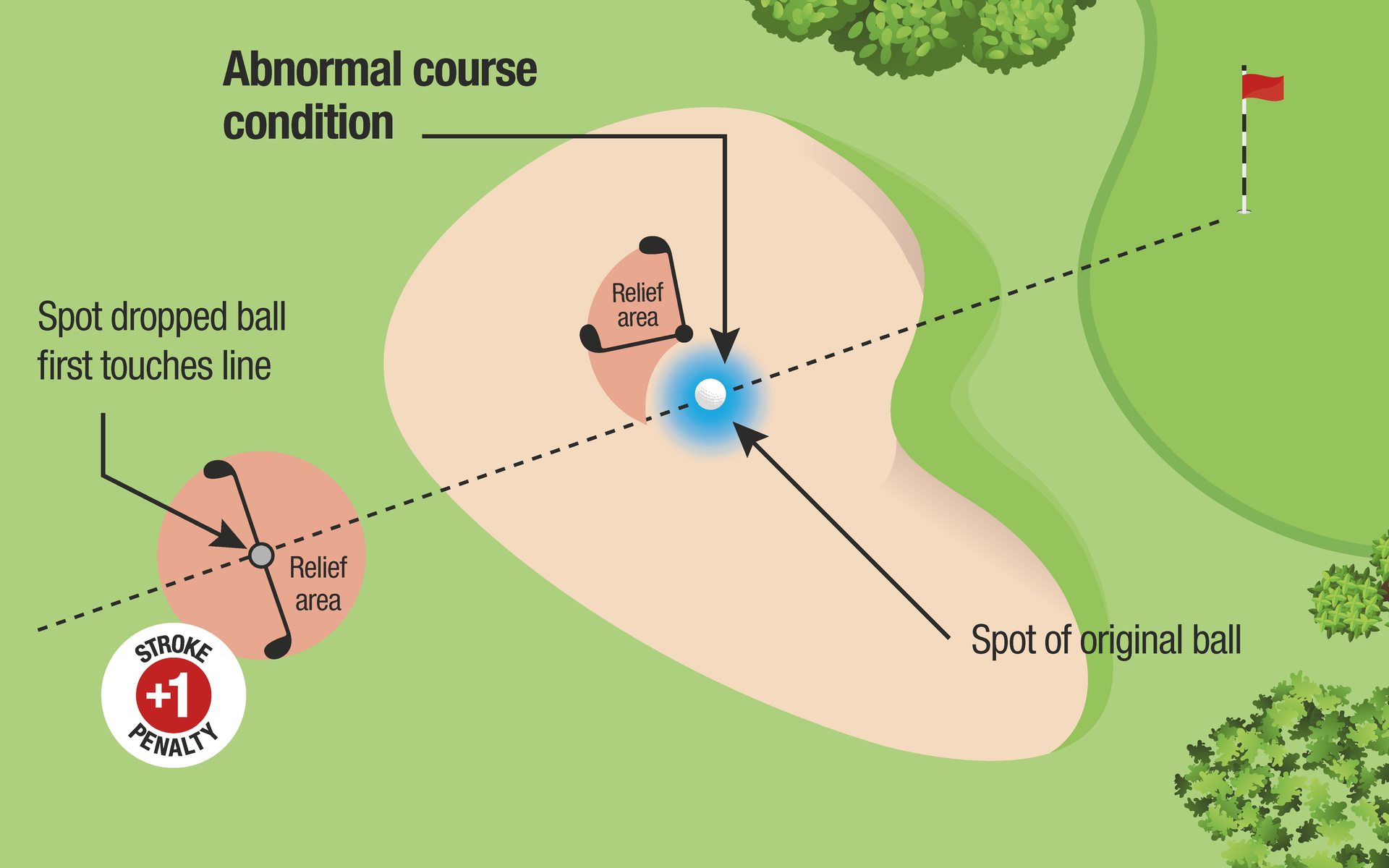 (2) Penalty Relief: Playing from Outside Bunker (Back-on-the-Line Relief). For one penalty stroke, the player may drop the original ball or another ball (see Rule 14.3) outside that bunker, keeping the spot of the original ball between the hole and the spot where the ball is dropped (with no limit on how far back the ball may be dropped). The spot on the line where the ball first touches the ground when dropped creates a relief area that is one club-length in any direction from that point, but with these limits:
- The nearest point of complete relief and the relief area must be in the bunker.
- If there is no such nearest point of complete relief in the bunker, the player may still take this relief by using the point of maximum available relief in the bunker as the reference point.
MCHORO 16.1c: NAFUU KUTOKANA NA HALI ISIYO YA KAWAIDA YA UWANJA NDANI YA BANKA
- Mchoro unadhani mchezaji anatumia mkono wa kulia.
- Wakati kuna kikwazo kutoka kwa hali isiyo ya kawaida ya uwanjani ndani ya banka, nafuu ya bure inaweza kutolewa ndani ya banka chini ya Kanuni 16.1b au nafuu ya kurudi nyuma kwenye mstari inaweza kutolewa nje ya banka kwa adhabu ya mkwaju mmoja.
- Nafuu nje ya banka hutolewa kwa kudondosha mpira katika sehemu inayohakikisha kuwa sehemu mpira ulikokuwa awali inabaki kati ya shimo na sehemu hiyo mpya.
- Eneo la nafuu ni urefu wa fimbo moja katika mwelekeo wowote kutoka sehemu ambapo mpira uliigusa ardhi mara ya kwanza ulipodondoshwa.
- Limits on Location of Relief Area:
- Must not be nearer the hole than the spot of the original ball, and
- May be in any area of the course except the same bunker, but
- Must be in the same area of the course that the ball first touched when dropped.
16.1d
Relief for Ball on Putting Green
If a player’s ball is on the putting green and there is interference by an abnormal course condition on the course, the player may take free relief by placing the original ball or another ball on the spot of the nearest point of complete relief, using the procedures for replacing a ball under Rules 14.2b(2) and 14.2e.
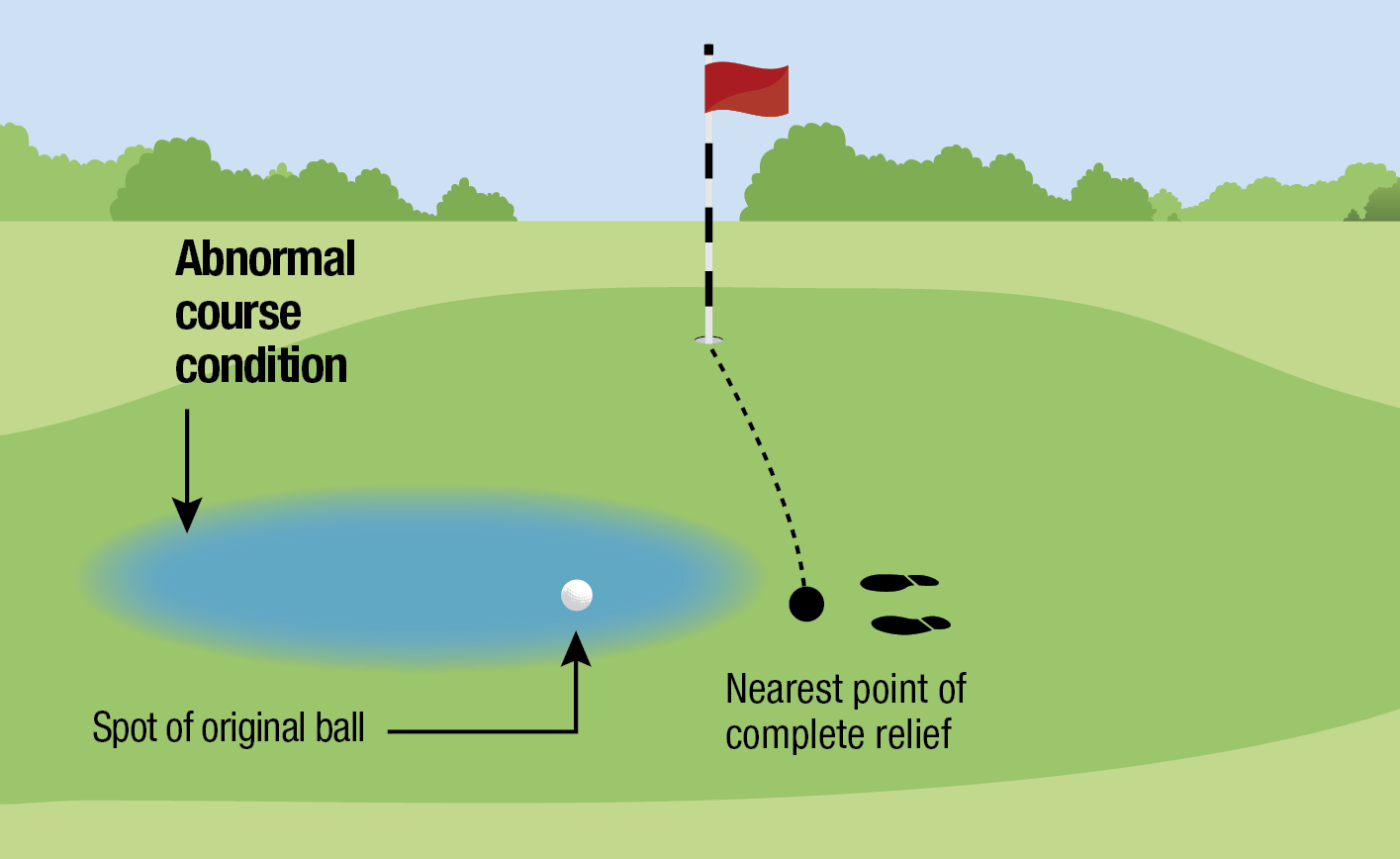
- The nearest point of complete relief must be either on the putting green or in the general area.
- If there is no such nearest point of complete relief, the player may still take this free relief by using the point of maximum available relief as the reference point, which must be either on the putting green or in the general area.
DIAGRAM 16.1d: FREE RELIEF FROM ABNORMAL COURSE CONDITION ON PUTTING GREEN
- The diagram assumes the player is left-handed.
- When a ball is on the putting green and there is interference by an abnormal course condition, free relief may be taken by placing a ball on the nearest point of complete relief.
- The nearest point of complete relief must be either on the putting green or in the general area.
16.1e
Relief for Ball Not Found but in or on Abnormal Course Condition
If a player’s ball has not been found and it is known or virtually certain that the ball came to rest in or on an abnormal course condition on the course, the player may use this relief option instead of taking stroke-and-distance relief:
- The player may take relief under Rule 16.1b, c or d, using the estimated point where the ball last crossed the edge of the abnormal course condition on the course as the spot of the ball for purposes of finding the nearest point of complete relief.
- Once the player puts another ball in play to take relief in this way:
- The original ball is no longer in play and must not be played.
- This is true even if it is then found on the course before the end of the three-minute search time (see Rule 6.3b).
16.1f
Relief Must Be Taken from Interference by No Play Zone in Abnormal Course Condition
In each of these situations, the ball must not be played as it lies:
(1) Relief When Ball Is in No Play Zone Anywhere on Course Except Penalty Area. If the player’s ball is in a no play zone in or on an abnormal course condition in the general area, in a bunker or on the putting green:
- No Play Zone in General Area. The player must take free relief under Rule 16.1b.
- No Play Zone in Bunker. The player must take free relief or penalty relief under Rule 16.1c(1) or (2).
- No Play Zone on Putting Green. The player must take free relief under Rule 16.1d.
- Take relief if allowed under Rule 16.1b, c or d, depending on whether the ball is in the general area, in a bunker or on the putting green, or
- Take unplayable ball relief under Rule 19.
16.2
Dangerous Animal Condition
16.2a
When Relief Is Allowed
A “dangerous animal condition” exists when a dangerous animal (such as venomous snakes, stinging bees, alligators, fire ants or bears) near a ball could cause serious physical injury to the player if they had to play the ball as it lies.
A player may take relief under Rule 16.2b from interference by a dangerous animal condition no matter where their ball is on the course.
This Rule does not apply to other situations on the course that could cause physical harm (such as a cactus).
16.2b
Relief for Dangerous Animal Condition
When there is interference by a dangerous animal condition:
(1) When Ball Is Anywhere Except Penalty Area. The player may take relief under Rule 16.1b, c or d, depending on whether the ball is in the general area, in a bunker or on the putting green.
(2) When Ball Is in Penalty Area. The player may take free relief or penalty relief:
- Free Relief: Playing from Inside Penalty Area. The player may take free relief under Rule 16.1b, except that the nearest point of complete relief and the relief area must be in the penalty area.
- Penalty Relief: Playing from Outside Penalty Area.
- The player may take penalty relief under Rule 17.1d.
- If there is interference by a dangerous animal condition where the ball would be played after taking this penalty relief outside the penalty area, the player may take further relief under (1) without additional penalty.
- When playing the ball as it lies is clearly unreasonable because of something from which the player is not allowed to take free relief (such as when a player is unable to make a stroke because of where the ball lies in a bush).
- When interference exists only because a player chooses a club, type of stance or swing or direction of play that is clearly unreasonable under the circumstances.
16.3
Embedded Ball
16.3a
When Relief Is Allowed
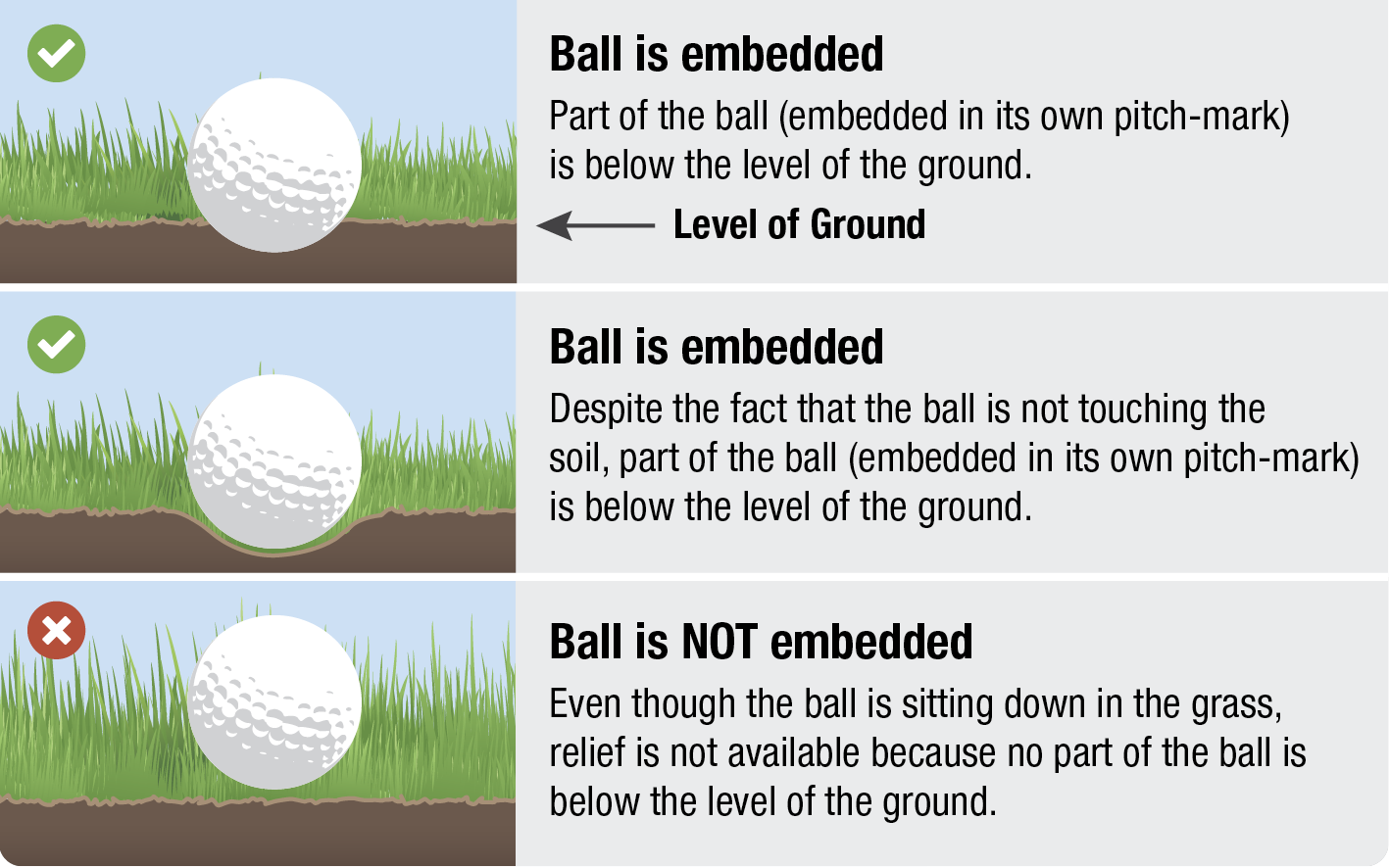
(1) Ball Must Be Embedded in General Area. Relief is allowed under Rule 16.3b only when a player’s ball is embedded in the general area.
- There is no relief under this Rule if the ball is embedded anywhere except in the general area.
- But if the ball is embedded on the putting green, the player may mark the spot of the ball and lift and clean the ball, repair the damage caused by the ball’s impact, and replace the ball on its original spot (see Rule 13.1c(2)).
- When the ball is embedded in sand in a part of the general area that is not cut to fairway height or less, or
- When playing the ball as it lies is clearly unreasonable because of something from which the player is not allowed to take free relief (such as when a player is unable to make a stroke because of where the ball lies in a bush).
- It is in its own pitch-mark made as a result of the player’s previous stroke, and
- Part of the ball is below the level of the ground.
- The ball is pushed into the ground by someone stepping on it,
- The ball is driven straight into the ground without becoming airborne, or
- The ball was dropped in taking relief under a Rule.
MCHORO 16.3a: WAKATI MPIRA UMEZAMA ARDHINI
16.3b
Relief for Embedded Ball
When a player’s ball is embedded in the general area and relief is allowed under Rule 16.3a, the player may take free relief by dropping the original ball or another ball in this relief area (see Rule 14.3):
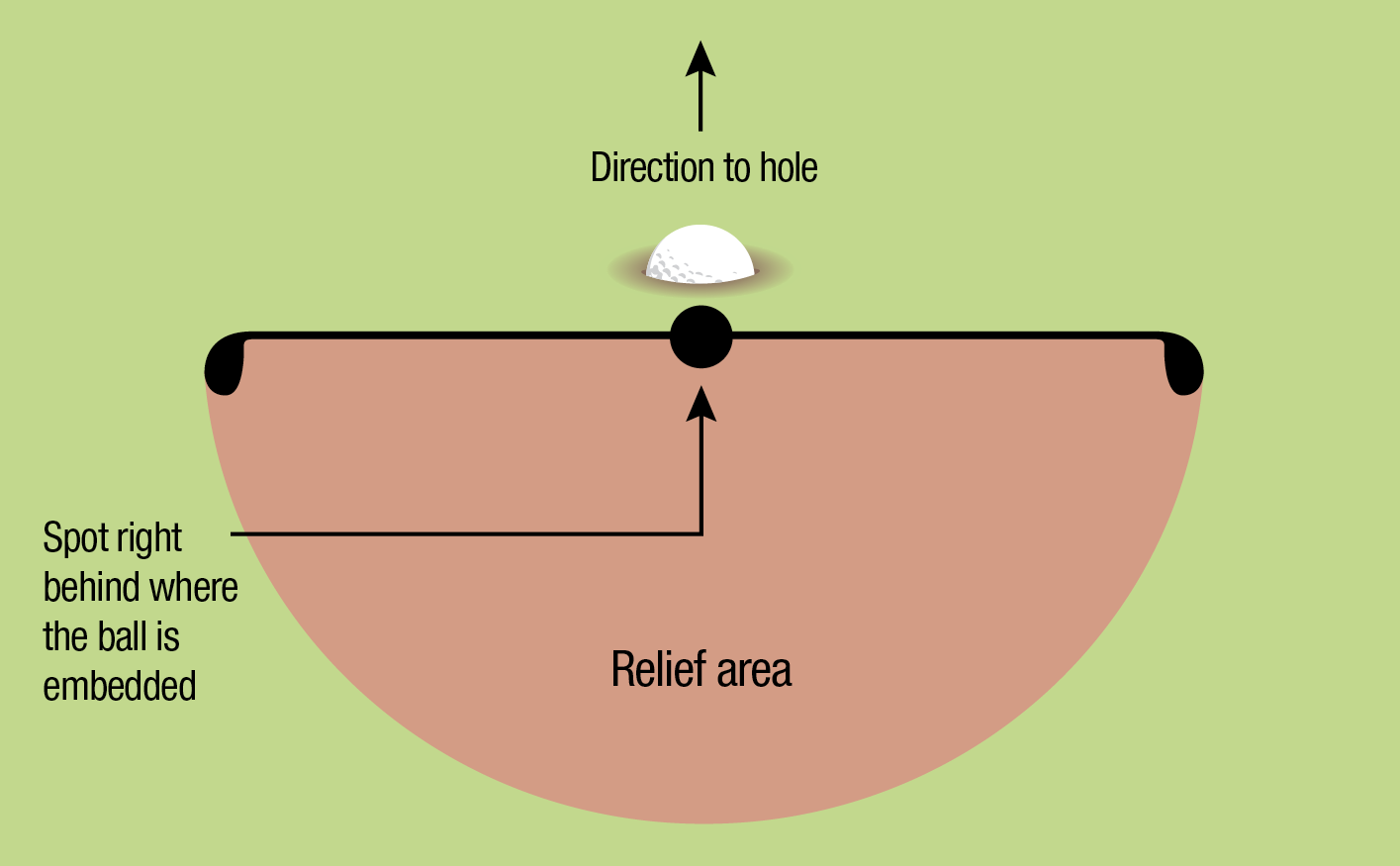
- Reference Point: The spot in the general area right behind where the ball is embedded.
- Size of Relief Area Measured from Reference Point: One club-length, but with these limits:
- Limits on Location of Relief Area:
- Must be in the general area, and
- Must not be nearer the hole than the reference point.
DIAGRAM 16.3b: FREE RELIEF FOR EMBEDDED BALL
- When a ball is embedded in the general area, free relief may be taken.
- The reference point for taking relief is the spot in the general area right behind where the ball is embedded.
- The relief area is one club-length from the reference point, is not nearer to the hole than the reference point and must be in the general area.
- A ball must be dropped in and come to rest in the relief area.
16.4
Lifting Ball to See If It Lies in Condition Where Relief Allowed
If a player reasonably believes that their ball lies in a condition where free relief is allowed under Rule 15.2, 16.1 or 16.3, but cannot decide that without lifting the ball:
- The player may lift the ball to see if relief is allowed, but:
- The spot of the ball must first be marked, and the lifted ball must not be cleaned (except on the putting green) (see Rule 14.1).
- The player gets one penalty stroke if they did not mark the spot of the ball before lifting it or cleaned the lifted ball when not allowed, and
- The ball must be replaced on its original spot (see Rule 14.2).